

Fighting corruption is not a one-institution mandate but rather a collective responsibility of all Namibians.
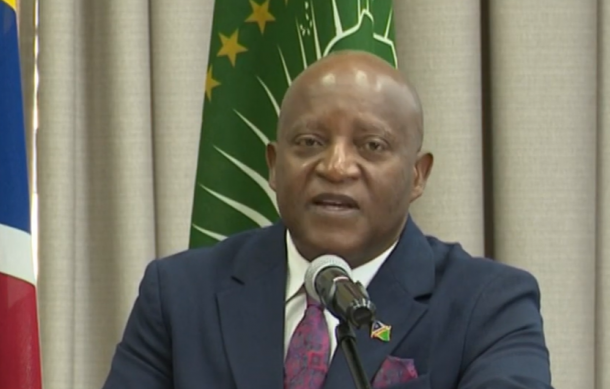
These sentiments were shared by the Prime Minister, Elijah Ngurare, during the National Anti-Corruption Strategy Steering Committee Meeting held in Windhoek today.
The Premier says if corruption is not effectively dealt with, it will destroy the economic gains made to date.
Corruption, he further says, undermines service delivery, widens inequality, weakens the confidence and trust of citizens in public institutions and ultimately compromises the future of the entire nation.
"Amongst many, many things that we can do, it is best if we work together in UNDP. It is best if we work together with synergy. the president has been saying. Let's continue to make sure that corruption is treated as treason because it deprives the weak who are meant to benefit from the resources. So that is the unity I appeal to."
The National Anti-Corruption Strategy Steering Committee meeting is the highest monitoring body of the National Anti-Corruption Strategy and Action Plan.
The Steering community is composed of ministers, executive directors and heads of institutions, and it's responsible for providing strategic oversight and ensuring the successful implementation of the National Anti-Corruption Strategy.
"At the regional level, there are strategic regional forums chaired by the regional governors, and that's why our honourable governors are among our mates. This monitoring mechanism was taken by the Namibian citizens, not by the anti-coronavirus commission. It was the Namibian citizens who decided on the set of structures. During their participation, we were consulting in the region on the development of the strategy, says Director General of ACC, Paulus Noa.
The first National Anti-Corruption Strategy and Action Plan was implemented from 2016 to 2019, laying a strong foundation for the second strategy - ending this financial year.
With support from the United Nations Development Programme (UNDP), an independent evaluation consultant was appointed, providing a synopsis of evaluation findings and the way forward for the development of the third strategy and action plan for 2026/2030.
Resident Representative for UNDP, Amanda Serumaga, says, "Progress has been made, but not at a pace, on a scale, and with the visibility that citizens are looking for." What the evaluation tells us plainly is that progress is real, but citizens want to feel it. The evaluation recognises genuine efforts. Systems have improved. Institutions are stronger. Awareness has grown."
The meeting highlighted the need for anti-corruption to be embedded in every ministry, every regional council, every local authority, and every state-owned enterprise.