


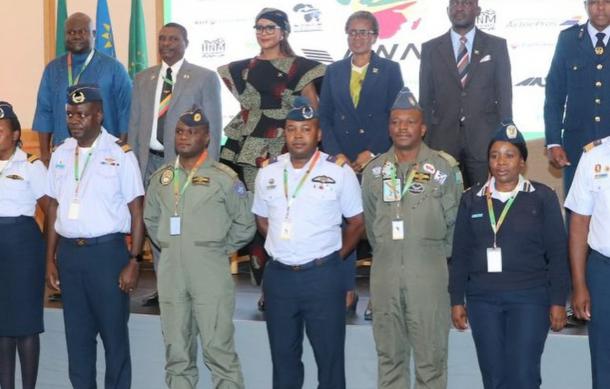
The Namibian Air Force envisions improved civil-military cooperation beyond the country's borders.
This was revealed during a three-day Aviation Week Africa Exhibition Summit in Windhoek, which ended on Friday.
The Namibian Air Force delegation at the summit demonstrated a clear vision of strengthening civil-military aviation cooperation, advancing innovation, and promoting regional collaboration in Africa's aviation sector.
Their participation highlighted Namibia's commitment to aviation development, safety, skills transfer, and strategic partnerships that will contribute to the growth of the industry across the continent.
Air Vice Marshal Teofelus Shaende, the Commander of the Namibian Air Force, said, "Military aviation plays a crucial role within the broader aviation ecosystem, extending its traditional defence functions. It ensures airspace sovereignty by maintaining the integrity and security of national airspace. Furthermore, it supports civil authorities through infrastructure development and infrastructure usage sharing, military-to-military diplomacy, and enhanced national response to crises and search and rescue operations."
The summit sparked open discussions among civilian and military experts.
Group Captain Engelhard Koujo, Commandant of the School of Air Power Studies, stressed structured collaboration: "The civil-military interface in this domain is continuous and structured, of course, with both the National Civil Aviation Authority (NCAA) and the Namibian Defence Force as custodians of the Namibian Air Force. This carries responsibility for maintaining and securing a safe airspace environment. This collaboration ensures that indigenous safety is protected while enabling the efficient movement of civil aircraft."
Harriet Angatile, Director of Airport Services from Zambia, echoed the need for teamwork: "On the other hand, we do have the military, whose responsibility is to protect the integrity of our airspace. So in both cases, I think our space requires collaboration because we have two different missions, yet we are expected to use the same airspace."
Wing Commander Abner Elishi, Officer in Charge of Air Operations, outlined key priorities: "The key areas of interest for the Namibian Air Force include interoperability with civil aviation systems to ensure efficient airspace use. This includes technology modernisation, especially in surveillance, air navigation, and emerging innovations."
Sqn Ldr Zane Claasen, Officer in Charge of the Training Wing, detailed training efforts: "Technical training is where we teach technicians or mechanics in-house on how to repair and maintain our platforms. The flying training wing is where we envision training student pilots, and at the moment, we are doing conversion for pilots to the K-8 platform."