


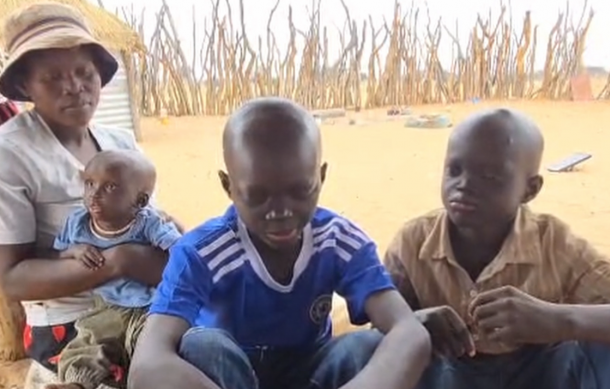
Watching a child battle a rare medical condition can be a draining journey.
A resident of Ashipepe in the Oshikoto Region, Indileni Haidula, is dealing with not one but four children, with a rare condition that requires them to have access to water all the time. It is a commodity, however, that is almost out of reach.
In villages, there are untold stories of struggle - battles that many families fight in silence.
Our news team was led to the family of 43-year-old Indileni Haidula, a single mother of eight.
Of her eight children, four have a condition called ectodermal dysplasia – where children's teeth fail to develop and they have a lack of hair.
They were nine, but she lost one to the condition in 2005 at the age of five.
Because they have no teeth, they only eat soft food, which the government's social grant they mostly rely on is insufficient to keep up with.
"My child was only five years old. She went to fetch water but never returned home due to the extreme heat at the time. I have lived with that fear until now. He had skin like his; we splash water on their bodies (skin) because they do not sweat," narrates Haidula.
The genetic condition affected four other relatives who are no longer alive.
"It is a difficult situation, and I am facing it alone. I have been a single mother; the fathers ran away when they realised that their children had a health condition. In my village, we have become like outcasts. Some people label me and call my children chimpanzees or monkeys. Others call me cursed. I thank God for the strength He has given me. I never thought of neglecting my children, and my love for them remains the same. The children no longer go to school because of the sun, the distance they have to travel, and the bullying they experience at school."
Haidula has two sets of twins. Her eldest son, Gabriel, is 24 and has a twin sister.
He had only gone up to grade 8 and had to carry a container of water with him everywhere he goes.
The youngest are eight-month-old twins.
"We cannot walk long distances. We tried digging three wells in the field near home, but I could not find water; some dried up. We walk extremely long distances to access water. We need help, so we can survive better," said Thomas.
It takes them two hours to walk to the water source, and there are times that the source is dried up.
But children have to ensure that they have wet clothes around their necks to keep them moist.
"I am pleading for a tap to be installed in my home to enable us to have access to clean water and prevent them from walking long distances. I am calling on the government to help us," pleads Haidula.
Petrus Theofelus is a community activist at Ashipepe village.
"I came across the family during our community outreach; people with this condition are in the country, and they need help. I am calling on our good Samaritans to cooperate to assist with a water tank or tap; the children also need a special school hostel, as they are just home. The government should visit this family as soon as possible to assess the situation that needs urgency."
Ectodermal dysplasias are disorders that affect the skin, sweat glands, hair, teeth, and nails.