


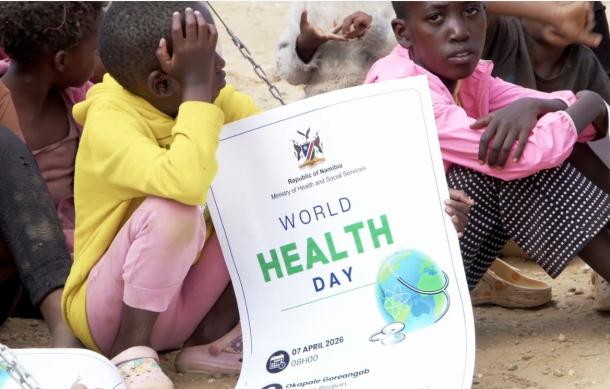
The Deputy Minister of Health and Social Services has reaffirmed the government's commitment to safeguarding public health through science-based strategies, stronger outreach and cross-sector collaboration.
Susanna Ndjaleka, during the commemoration of World Health Day, emphasised Namibia's progressive health sector.
The event reflected on science‑based, cost‑effective tools such as vaccines that have eliminated or brought under control diseases such as smallpox and polio and turned HIV and tuberculosis into manageable conditions.
Ndjaleka linked environmental degradation, such as droughts, floods, and habitat loss, to the heightened risks of zoonotic diseases and food insecurity, stressing that human health declines when the ecological balance is broken.
She noted that, despite progress, malaria remains a heavy burden in Namibia.
Currently, there are 39,680 confirmed cases, 3,008 hospital admissions, and 44 deaths recorded since late last year.
She highlighted the role of environmental factors that fuel vector‑borne diseases and called for early testing, treatment, indoor residual spraying, and community awareness.
"Through our robust science-backed environmental surveillance, poliovirus type 2 was detected in Namibia in late 2025 and early this year, linked to the strain currently circulating in the broader South African region. I want to be clear, although no human has developed paralysis from this detection, its presence in our environment is a glaring warning. This is exactly what it means to stand with science. Science works exactly as it should. It detects the invisible threat early, long before widespread strategy or irreversible paralysis could occur in our community."
Cervical cancer, affecting about 350 women each year, with over 200 deaths, prompted the recent introduction of the HPV vaccine to protect future generations.
Data also show that conditions such as cardiovascular diseases, diabetes, and various cancers now account for a large share of deaths in Namibia.
Health workers were described as the central pillar of the national health system, especially in reaching remote communities through primary health care outreach.
Each region will receive one vehicle to enhance and accelerate health services, particularly in remote and hard-to-reach areas.