


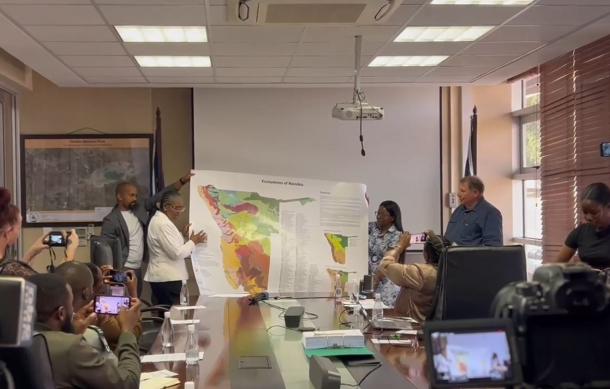
The Ministry of Environment, Forestry and Tourism has launched the Namibia Map of Ecosystems as part of the Southern Africa SBAPP Regional Project.
This five-year initiative, which includes Namibia, South Africa, Mozambique and Malawi, aims to enhance biodiversity data and processes and better inform development decisions.
The project will guide land-use planning, national policy development and biodiversity monitoring.
This will also direct agricultural expansion away from sensitive ecosystems, preventing conflicts between development and conservation, and strengthening community livelihoods that support tourism.
The project will solidify Namibia's environmental policies with scientific data, thereby enriching national biodiversity knowledge and facilitating future monitoring endeavours.
The Environment, Forestry, and Tourism Minister, Indileni Daniel, said Namibia is endowed with extraordinary ecological diversity; hence, there is a need to know where they are, how they function, and where they are most vulnerable.
"This map transforms science into action and empowers policymakers, planners and communities to make informed choices that protect our ecosystems while promoting inclusive development. It is also deeply integrated into Namibia's red list assessments. The red list of endemic and near-endemic plants developed by the National Botanic Research Institute, the red list of animals coordinated by the National Museum of Namibia, and the red list of ecosystems all complement the spatial outputs of this SBAP map."
The map classifies and spatially maps 218 distinct ecosystem types across Namibia.
Dr. Ben Strobach, a lecturer at NUST, led the description, assessment and mapping of Namibia's ecosystems.
"We are relatively often in the field. We are looking at these ecosystems in the field, and if you find mistakes, that is where the 2% comes in; we correct them. And when I'm busy, or we are busy rather, with a description of all these ecosystems, this is the first draft, basically a template for every single ecosystem with some of the baseline data in it already."
The map will further assist with environmental impact assessment, climate resilience strategies and natural resource management.