


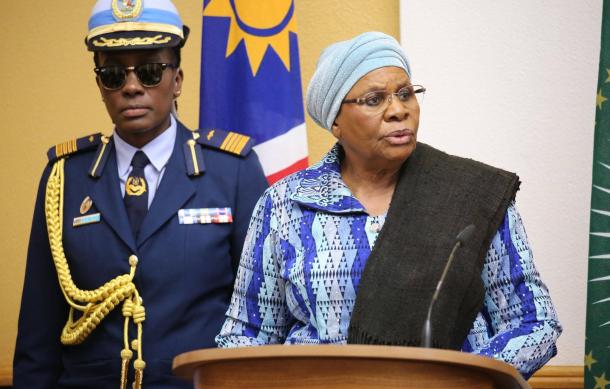
President Netumbo Nandi-Ndaitwah, in her second State of the Nation Address (SONA), outlined progress made by the eighth administration in the seven priority areas and economic enablers.
The SONA, with a main focus on economic development, was held under the theme "Advancing towards the Realisation of Vision 2030".
Dr. Nandi-Ndaitwah highlighted progress in agriculture through training and funding, the development of sports facilities nationwide, youth empowerment initiatives, and improvements in education, including subsidised education.
She also noted growth in the creative industries, enhanced healthcare services, and ongoing developments in land, housing and sanitation.
During the year under review, the President said 13 operational investment projects valued at N$4.3 billion generated more than 1,500 jobs registered, with fifteen projects worth more than N$63 billion underway.
"In an effort to strengthen the business climate, last year I hosted the inaugural Namibia Public-Private Forum, which led to the formation of Task Forces on economic recovery, health, and housing. I want to thank the Task Forces for having submitted their reports by the deadline of 31 March 2026; recommendations have been proposed for consideration. The ease of doing business has improved, with average waiting periods reduced from 21 to 14 days through the operationalisation of the One-Stop Shop."
The President further noted that the eighth administration's policy interventions through the eight critical economic enablers are producing results.
The enablers include mining, which generated over N$64 billion in export earnings, contributed N$1.4 billion in royalties, and created 580 jobs.
Energy consists of several projects, such as biomass, solar and other sources, that are underway, totalling over N$8 billion.
Once operational, they will boost electricity generation.
On tourism, national parks brought in a total of N$183 million from entrance and conservation fees, and conservancies earned N$109 million.
"Regarding infrastructure development, staff houses and offices at Hardap Game Park, Namutoni, Keetmanshoop, and Daan Viljoen Game Park have been renovated at a cost of N$4.4 million. Furthermore, 183 km of Etosha National Park has been upgraded, with an additional 15 km and 13 km of Mahango fencing completed. This initiative is aimed at improving tourism infrastructure, conservation efforts, and wildlife management, while reducing human-wildlife conflict and promoting biodiversity conservation."
Dr. Nandi-Ndaitwah further emphasised the importance of overseeing the oil and gas sector under the Presidency, which forms part of the enablers.
If not properly managed from the beginning, the President said, it could become a curse for the country.
Therefore, Nandi-Ndaitwah urged parliamentarians to pass the Petroleum Amendment Bill with urgency.
"Since its establishment, the Oil Unit has conducted successful benchmarking visits to Guyana, Angola, Norway, and Algeria. A government technical committee guided by the High-Level Team of ministers has also been established, and work has begun on the first phase of reviewing and providing input on the Field Development Plan batch submitted by Total Energies, marking an important initial step toward formal negotiations and final investment decisions."
She added, "At my request, the government of Norway has agreed to provide us with technical support. One of the Norwegian delegated officers who was part of the team that drafted the Namibia Petroleum Act of 1992 visited Namibia for a week last month, and they are currently in contact with the Oil Unit. The Oil Unit stands ready to engage the relevant parliamentary committee for additional information, as negotiations do not take place in the chamber."
Despite progress made, the President says several challenges persist that require attention and collective action.
The government faces fiscal pressures and competing budget priorities, requiring careful resource allocation to balance immediate needs with long-term development goals. There is also an urgent need to expand the domestic revenue base to secure sustainable funding for public services and strategic investments."
Another concern, she said, was "The economy’s ongoing reliance on primary sectors highlights the need to improve economic diversification efforts to strengthen resilience and lessen exposure to external shocks."