


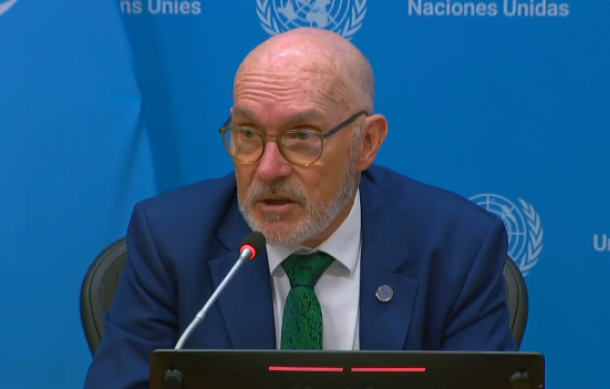
Robert Floyd, Executive Secretary of the Comprehensive Nuclear-Test-Ban Treaty Organization (CTBTO), emphasized the treaty’s enforcement as a key pillar in curbing the spread of nuclear weapons.
As preparations continue for the upcoming large-scale on-site inspection exercise (IFE26) scheduled in Namibia from 10 October to 20 November this year, Floyd addressed the UN Press Corps during the Review Conference of the Treaty on the Non-Proliferation of Nuclear Weapons.
He described the Comprehensive Nuclear-Test-Ban Treaty as central to any framework, banning nuclear explosions of all sizes and helping prevent the spread and advancement of nuclear weapons.
Floyd highlighted the CTBTO’s global monitoring system, capable of detecting nuclear explosions equivalent to 500 tons of TNT or more, regardless of location—underwater or underground:
“Any state that thinks of developing a nuclear weapon would need to test one and if they did, it will be known to all,” he said.
Despite having 187 signatories and 178 ratifications, the treaty has yet to enter into force, as nine countries still need to ratify it, leaving gaps in the verification regime.
Floyd warned that rising geopolitical tensions have brought nuclear testing back into focus:
“If one state tests, others would and even more would potentially then go into a spiral of expanded testing. That is a spiral that we do not want to see start because it may never be able to be stopped. We also have a situation where an allegation is made by one state against another state, where they say that testing has taken place and strongly denied by the other state. And so that causes there to be real interest and questions about the ability of our verification system to detect even the smallest of nuclear explosions, so that the states of the world would have confidence that they would know that no nuclear testing is taking place.”
The IFE26 exercises in Namibia will further test the organization’s readiness and capabilities, building on earlier drills in Kazakhstan (2008) and Jordan (2014).