


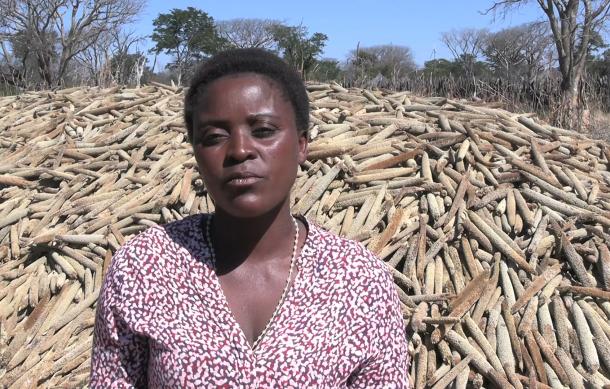
A 36-year-old woman from Gava village in the Kavango West Region is using small-scale mahangu farming to provide for her family after dropping out of school due to financial challenges.
Lydia Hamuponya dropped out of school in 2016 due to her humble background.
She started the Mahangu plantation project in 2023 with her partner Johannes Fillipus.
They produce Mahangu both for household consumption and for sale to the Agricultural Marketing and Trade Agency, AMTA.
The income generated goes directly toward household expenses and the upkeep of their children.
Despite the progress, the couple faces major setbacks such as high transport costs to deliver maize to AMTA's pickup points and fees paid to private milling machines which are cutting into their profits.
Lydia Hamuponya, a subsistence farmer, grumbles, "We look for transport ourselves; one bag of mahangu costs us 50 dollars for it to be transported to Kanyanga. Sometimes we think of selling a lot of Mahangu bags, but we sometimes cannot afford to pay for all the bags, and we are forced to reduce the bags. Like last year, I only managed to sell 50 bags, which was not my plan, but with the money I had at that time, I couldn't afford more bags."
Last year Hamuponya harvested 100 bags of mahangu, sharing that compared to this year's harvest, they might get about 150 bags.
Lydia's partner, Fillipus Johannes, says owning a milling machine would help reduce costs, as it will allow them to process maize themselves and increase earnings.
Adding that it would also enable them to serve other farmers in the village.
"As we stand, we do not even know how we are going to manage to mill all this mahangu, you see. Because for one bag some are charging N$60, others N$50. If those are the prices, how much will we spend for all this mahangu? Another thing when it comes to transportation: we have heard about AMTA assisting farmers to transport their crops from their storage to AMTA, but we have not seen that here. Just look at the distance you drove from the gravel road; we pay for transport from here to the gravel road, and then we pay from the gravel to the marketplace. We are already struggling."
The farmers are now appealing to government and development partners for assistance with a milling machine, hoping to grow the project and secure a better future for their family and community.