


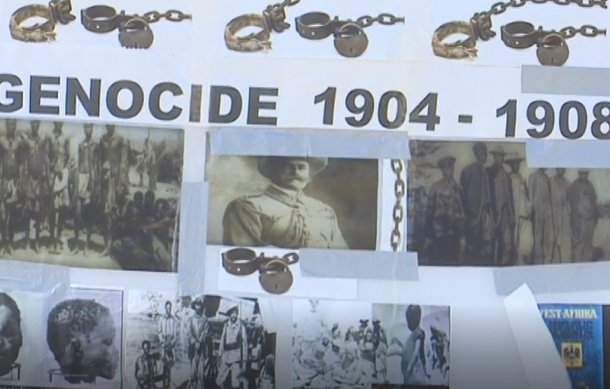
Twenty-eight May 1908 marked the official closure of the concentration camps that were run by the German colonial forces during the 1904-1908 genocide against the Ovaherero and Nama people.
Historian Dr. Martha Akawa-Shikufa reflects on this dark era as Namibia prepares to commemorate the National Genocide Remembrance Day for the first time.
Speaking to nbc News, the Associate Dean of the School of Humanitarian, Society, and Development at UNAM emphasized that when one talks about Namibia's independence, the Ovaherero and Nama people's genocide is one of the historical traumas rooted in the country's colonial history by Germany.
"With the war that started in January 1904, up to 1908/1909, if one has to consider some of the activities that continued. So when the war started, there were a lot of battles and lots of wins and losses. To mention specific battles that were very prominent in this war, one talks of the battle of Okandjira and the battle of Hamakari on August 11, 1904. That is the battle where one can say the Ovaherero people were defeated; some died, and some decided to flee."
After the Battle of Ohamakari, also known as the Battle of Waterberg, on the 2nd of October 1904, the German Commander at the time, Lothar von Trotha, issued an extermination order.
"Now this extermination order indicated that there were no longer going to be spared or taken as prisoners—women, men, anyone with or without cattle were going to be executed. So a lot of people decided to flee through the Omaheke, trying to get to Botswana. There was a lot of debate regarding the extermination order even in Germany itself; they felt this was very brutal. Even the missionaries that were in the country got involved, and then they decided to extract or remove the extermination order."
When the extermination order was removed, that is when colonial Germany established concentration camps.
These camps were located in Okahandja, Omaruru, Karibib, Windhoek, Swakopmund, and Shark Island.
"The concentration camps became, technically speaking, an extension of the extermination order because the aim and the outcome of the camps were not different from the extermination orders. The situation in there was very bad; people didn't have food, got sick, and people also worked to death. A lot of people died in the camps because of exhaustion. In fact, there were pre-printed death certificates stating death by exhaustion because that's how it was. They did not wait for someone to die; they already had death certificates waiting for them to die because they knew they would die."
The closure of these camps, Dr. Akawa-Shikufa says, came as a result of Germany losing World War I, and as a result, Germany was stripped of its overseas colonies, including Namibia, then known as German South West Africa at the time.
She says although the camps were closed on 28 May 1908 after Britain took over South West Africa as its colony, the prisoners of war at the time were not free.
"Because when we talk about the war, we are not only talking about the Ovaherero, because the genocide was also extended to the Nama. So you cannot pick any of the days that speak to this community and not to the other community; it makes sense to say which day can we pick that speaks to all the atrocities that were committed against the two communities, and that is why we have 28 May as a neutral day."
Dr. Akawa-Shikufa commended the Namibian government for setting a day aside to remember these atrocities against the Namibian people, adding locals should use it to reflect on those memories, the resilience of the survivors, and the historical journey toward justice and independence.