


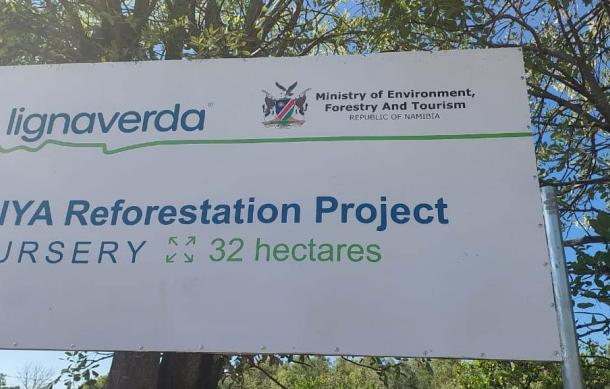
About 2,000 trees have died at the Lignaverda Reforestation project at Siya village in Kavango West.
Around 3,000 tree species were planted in February this year in an effort to restore degraded landscapes.
Earlier this year, Lignaverda, a Belgian-based NGO, in collaboration with the Ministry of Environment, Forestry and Tourism (MEFT), launched the Siya reforestation project.
The indigenous trees survived, but a lot of the commercial fruit trees died.
The whole idea around planting the trees is to understand the conditions required in an effort to successfully reforest some of the degraded landscapes in the Kavango regions.
It turns out some of the conditions around here are quite harsh.
Termites destroyed a number of trees, and so did the frost, amongst many other factors, explained Lignaverda's Country Manager, Selma Nasheya.
"Just two weeks ago we had some clouds forming, we had some raindrops, it was a bit cooler, and then suddenly it started becoming super windy, and now it's cloudless, and it's really, really hot, so these are some of the things we are learning, and we're seeing how best to adapt, and eventually we will see the connections between the land, the people, the animals, the plants, and so forth, and we know obviously that all of this will have an impact on our food sovereignty and food security, and I think these are some of the things that the project is identifying to see, 'Okay, what are some of the opportunities?'"
Nasheya talks about some of the losses.
"Avocados, some of our mangoes and our apples. The citrus plants have actually been quite resilient; they have not really been affected by the termites, but then shortly after that we also had-we were initially just watering manually, and this was also quite a challenge, and I think this also might have been a factor in the mortality rates, but now we do have an irrigation system that has been installed."
While they are busy working on replacing the trees, they are also taking notes on where they can improve this time around. Some of the changes include capitalising on the rainy season while collaborating with local and international universities.
"They installed devices that are measuring soil moisture levels as well as both soil temperature and also, underneath the first, I would say 8 to 10 centimetres on the surface temperature as well as the microclimate temperature, so just a few centimetres above the soil we are also measuring that to see what is happening and also just to make the connections between the conditions as well as the climatic changes in order for us to be able to have data that can help us to be more informed in making the decisions for improving the project."
Nasheya says this is a high-cost research project, but losses like these are instrumental in actually minimising the risks and losses for the larger population.