


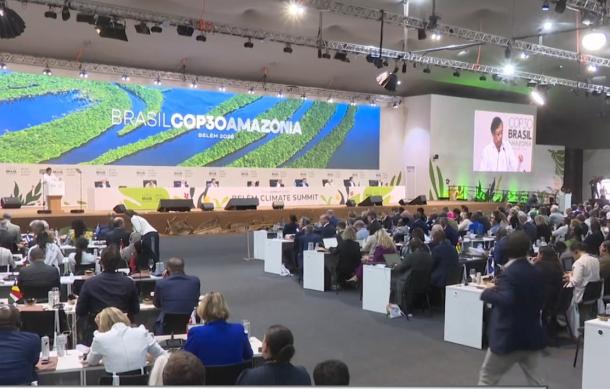
United Nations (UN) Secretary-General António Guterres has pointed out the failure to keep global warming below the threshold of 1.5 degrees Celsius, set by the 2015 Paris Agreement.
Addressing the Plenary of Leaders at the Belém Climate Summit in Brazil, Guterres condemned this shortfall as a moral failure and an act of deadly negligence.
According to the World Meteorological Organisation (WMO), 2025 is the second or third hottest year in over 170 years.
Guterres said the world is heading into dangerous territory, where even a brief period above 1.5 degrees Celsius could push ecosystems beyond irreversible tipping points and expose billions to unlivable conditions that fuel conflict, hunger and displacement.
He warned that because of the world's continued dependence on fossil fuels, surpassing the 1.5°C limit is now inevitable, likely by the early 2030s.
Despite progress in new Nationally Determined Contributions, Guterres noted that current commitments still fall short, leaving the world on track for more than 2°C of warming.
The UN Chief, while outlining plans for action, urged leaders to adopt a paradigm shift to make the overshoot as small as possible and called for rapid emissions cuts, a full fossil fuel phase-out and deep investment in adaptation and resilience.
"Let us be clear: the 1.5°C limit is a red line for humanity. It must be kept within reach. Short - by reaching global net zero by 2050 and moving swiftly to sustained net-negative emissions afterwards. Safe - by drastically increasing investments in adaptation and resilience, and delivering Early Warnings for All by 2027."
He highlighted the rapid growth of clean energy, noting that solar and wind are now the cheapest and fastest-growing power sources in history, with 2 trillion invested in clean energy in 2024, 800 billion more than in fossil fuels.
"Too many corporations are making record profits from climate devastation - with billions spent on lobbying, deceiving the public and obstructing progress. Too many leaders remain captive to these entrenched interests. Too many countries are starved of the resources to adapt - and locked out of the clean energy transition. And too many people are losing hope that their leaders will act. We need to move faster - and move together," he stressed.
The Secretary-General reaffirmed the UN's commitment to support developing nations through its Climate Promise initiative and directed the UN Development Programme (UNDP) to help countries move from planning to implementation.