


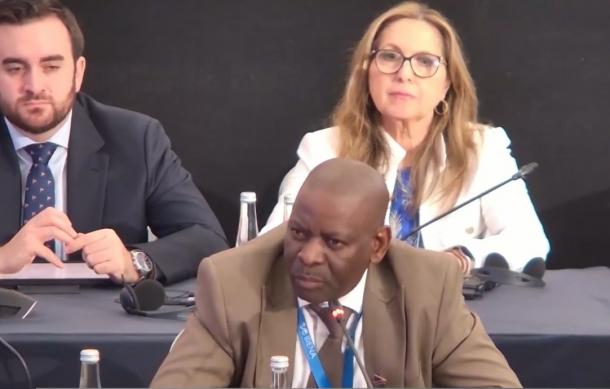
Members of Parliament attended the sixteenth session of the Assembly of the International Renewable Energy Agency (IRENA) in Abu Dhabi, under the theme "Powering Humanity: Renewable Energy for Shared Prosperity".
Namibia is represented by Deputy Speaker of the National Assembly, Phillipus Katamelo.
The International Renewable Energy Agency Assembly brought together over 1,500 participants.
Member states view Namibia as a fast-moving market with a clear strategy, strong political backing, and emerging green hydrogen leadership.
Namibia's Deputy Speaker of the National Assembly, Phillipus Katamelo, informed attendees that the country's momentum in green hydrogen did not arise from a single policy decision.
He explained that it took a sequence of deliberate reforms that created clarity, credibility, and confidence for investors.
“The green hydrogen aspect was indicated as an economic pillar that will drive economic activity for the country. And as such, it was incorporated in Vision 2030, the Fifth National Development Plan, and Namibia's climate commitment towards green hydrogen. So we already have those phenomena framed as the framework of engagement and as a basis for inculcating a universal arrangement towards green hydrogen. This alignment resulted in policy certainty and also gives long-term confidence within the market in terms of green hydrogen.”
Katamelo further stated that institutional coordination and procurement clarity unlocked delivery.
He added that private sector entry frameworks were intentionally de-risked following the adoption of a partnership-led model, using competitive processes, strategic MoUs, and phased project development rather than ad hoc licensing.
This, Katamelo said, balanced public oversight with private innovation while ensuring national value creation.
“There was access to land or state land that was clearly defined, as to how access to state land and environmental and social assessment validations that were required were already de-risked and addressed early in the beginning. And that also helped streamline the process in terms of creating and erasing the bottlenecks. Fourthly, there was a risk-sharing arrangement that was clearly embedded within the system in which the government dealt with the planning and institutional risk and the private developers dealt with the operational and construction risks associated.”
The International Assembly started on Saturday and ended today.