


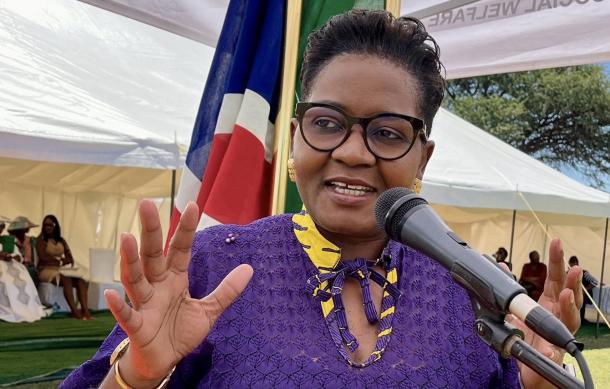
The Minister of Gender Equality and Child Welfare (MGECW) says mothers can leave a child in a safe place at various identified places in accordance with the current Act, instead of abandoning them at unsafe sites.
Dr Emma Kantema, however, highlighted some exceptions, which include leaving the child in the physical presence of another person, and the child must not show any signs of harm or abuse.
The places where children can be abandoned safely include police stations, fire stations, hospitals, schools, children's homes, or any other prescribed places without facing charges.
Furthermore, the person who left the child with an approved authority may seek to reclaim the child within 60 days of the date when the child was dropped off.
The person claiming responsibility for the child must be able to provide some identifying characteristics that have not been publicly disclosed. However, DNA testing can be used if there is doubt.
"If one then uses these designated places, you do not face criminal charges. So we decriminalise those places. But remember, the conditions must still be met, that you do not leave a child who has been abused, who is harmed, or in places where you do not see that it's being frequently used. So this then provides that the child can be handed over to this place, and it will not be decriminalised because it will be decriminalised because there's a person where you are leaving the child, knowing that the child will not be harmed."
Dr Kantema urged mothers to follow proper procedures to avoid prosecution, noting that the ministry provides counselling through social workers and offers several care options.
These include kinship care, where a child is placed with a relative through a voluntary agreement; foster care, which is court-ordered; and placement in a place of safety. She emphasised that these options do not remove parental rights.
Adoption remains the final option, where all parental rights and responsibilities are legally transferred to adoptive parents. While the process can be lengthy, it is available as a permanent solution.
"That's why I mentioned that we take you through with the social workers because even as a mother you might still need counselling for that. The support includes counselling to ensure that you understand, firstly, what the process entails. You understand the implications of giving up your child and the signing of the consent and also the consequences of the adoption order. So this is also then done by a court order."
The ministry identified some factors that lead to child abandonment, which include, among others, paternity denial, poverty and unemployment, fear and stigma, rape, lack of awareness, and post-mortem depression.
However, Dr Kantema urged mothers to explore various options before unsafely dumping their children.
"So I'm really urging all Namibians out there: let's seek help when we are in need. Help does exist. The government is really trying by all its means to ensure that we provide the help, whether it's the Minister of Health in terms of issues of nutrition or in terms of parental advice. A few weeks ago, together with the Minister of Health, we just launched a parental care handbook that will be rolling out to our frontline workers, traditional authorities, and community leaders."