


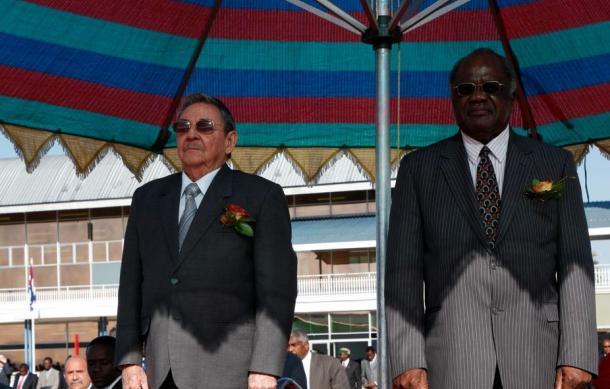
Former Cuban President Raul Castro today celebrates his 95th birthday against the backdrop of ever-increasing pressure from the United States government, underlined by a US Department of Justice indictment.
Born on the third of June 1931 in the Biran Province, Castro was part of the 26 July 1953 attack on the Moncada barracks, an attack led by his brother Fidel Castro.
The attack was not a success but was the spark that eventually led to the overthrow of the US-backed Fulgencio Batista government in 1959, ushering in a new revolutionary Castro government.
Raul Castro served as the minister of the armed forces from 1959 to 2008, when he took over from Fidel Castro on 24 February 2008.
Hardly a year after he became president, Raul Castro paid a state visit to Namibia and was hosted by then-President Hifikepunye Pohamba.
During the 2009 visit, he also met with the late founding president, Sam Nujoma, and laid a wreath at the Heroes' Acre.
Castro was accompanied by his vice president of the Council of Ministers, Ricardo Ruiz; foreign affairs minister Rodriguez Parilla; informatics and communications minister Ramiro Menendez; deputy minister of the armed forces Leopoldo Frias; as well as close to 100 other officials.
Approximately 4000 Namibians studied in Cuba between 1978 and Independence in 1990.
On 20 May this year, the US Department of Justice officially indicted Raúl Castro, relating to a 1996 incident in which the Cuban military allegedly shot down two unarmed civilian planes operated by Brothers to the Rescue.
The Cuban government and President Miguel Díaz-Canel strongly condemned the U.S. indictment of former President Raúl Castro, dismissing the charges as a politically motivated stunt to justify future military aggression or regime change.