


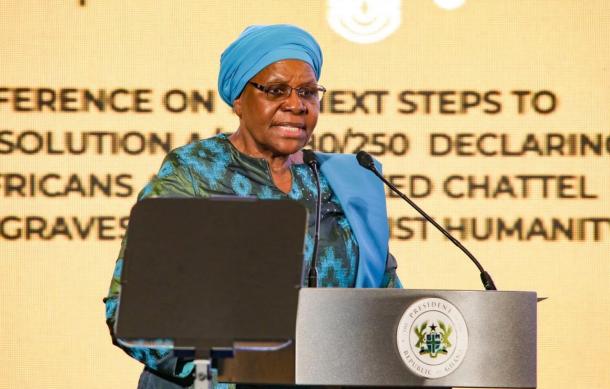
President Netumbo Nandi-Ndaitwah has used the High-Level Consultative Conference on the Next Steps for the Landmark UN Resolution on the Transatlantic Slave Trade in Accra, Ghana, to draw parallels between its legacy and Namibia's ongoing pursuit of reparations for the genocide committed against the Herero and Nama communities by German colonial forces.
President Nandi-Ndaitwah challenged Africa and the international community to confront painful chapters of history and turn acknowledgement into action.
She says the pursuit of restorative justice is not about resentment but about securing truth, dignity, and lasting reconciliation for generations affected by the atrocities.
These conversations, according to the Head of the State, extend beyond slavery as they reflect the continent's broader push toward justice.
“Africa is seeking to heal wounds that were never healed. The struggle for restorative justice is not driven by bitterness. It is driven by the belief that genuine reconciliation can only be achieved when truth is acknowledged, dignity is restored, and history is confronted with honesty.”
Over the years, Namibia has been engaging Germany over the genocide of the Herero and Nama communities between 1904 and 1908, after Parliament adopted the motion in 2006 on genocide, apology, and reparations.
President Nandi-Ndaitwah acknowledged that the negotiations have been challenging and appealed for patience.
“We remain engaged, as a solution has to be found. It is a fact that lasting reconciliation can only be built on truth, acknowledgement, and mutual respect. For many Namibians, the genocide did not end in 1908. Its echoes continue to this day. The remains of some of those who were killed were removed from our country and transported to Germany, where they became objects of study, research, display, and collection. As Africans, we are not asking the world to carry our pain for us. We are simply asking that our pain be heard, understood, and respected on its terms.”
Host President John Mahama revealed support is building internationally to confront the legacy of slavery and historical injustice since the adoption of the UN resolution in March this year.
“Indeed, since the resolution, we've witnessed significant acts of acknowledgement and reflection by religious institutions, including the historic statement by His Holiness Pope Leo XIV, as well as ongoing engagements by the Church of Scotland and the Church of England regarding their historical links to slavery. We also welcome the growing engagement of national leaders and governments in advancing dialogue on historical justice, including from France. Such developments are significant because they demonstrate a willingness to engage with difficult truths and to confront history honestly.”
One of the expected outcomes of the Accra conference is to develop a roadmap for advancing reparations, historical injustice, and the return of African cultural heritage.
President Mahama commissioned three global panels to drive these and other decisions in the implementation of the UN resolution, declaring slavery one of the gravest crimes against humanity.