


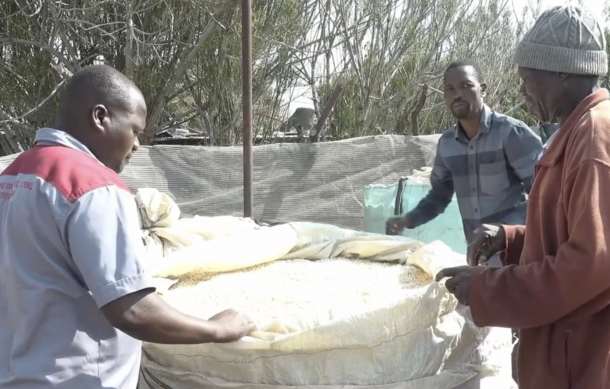
Beneficiaries at the Neu Sommerau Resettlement Farm on the outskirts of Kombat in the Otavi Constituency are celebrating a successful maize harvest of about 120 tonnes, despite operating under difficult conditions.
The harvests, which were produced under difficult circumstances, are expected to provide much-needed income to the farmers.
The harvest was made possible through support from the Ministry of Agriculture, Fisheries, Water and Land Reform, which provided seeds, fertilizer, diesel and mechanisation services.
Neu Sommerau currently hosts 46 farmers, each allocated four hectares of land.
This season, however, only two hectares per beneficiary could be ploughed due to limited tractors, implements, diesel and budget constraints.
Even so, the project is expected to produce around 120 tonnes of maize, offering much-needed income for the participating households.
A beneficiary, Ausona Timoteus, explained.
"We only manage to cultivate two hectares because there are not enough tractors, diesel and seeds. We also don't have water, and our fields are far from where we live. We appeal to the government to provide more tractors, enough diesel, boreholes and resettlement documents so that we can improve our livelihoods.”
The beneficiaries said, despite being resettled more than two decades ago, many are still without official documentation confirming their resettlement status.
They pointed out that the absence of these documents makes it difficult to access services and creates uncertainty over their future on the farm.
“We are pleading for the documents that state that we are the beneficiaries here. It would really free us from all these troubles. We were allocated about 42 hectares, but when we look at the land, we cannot cultivate all the hectares allocated to us because we do not have enough farming implements,” added Timotheus.
Project Coordinator of the Ministry of Agriculture, Johannes Hango, noted that it continues to support the project by supplying production inputs, maintaining tractors and assisting with marketing the maize after harvest.
He acknowledged, however, that limited funding and equipment are restricting the project's full potential.
“We demarcated four hectares per person, and then we do the ploughing for the individuals. After we have finished ploughing, the ministry will be responsible—or rather, we at the office will be responsible—for finding a market for the produce. Once we have sold the produce, the beneficiaries will be paid for the work that we have done.”