


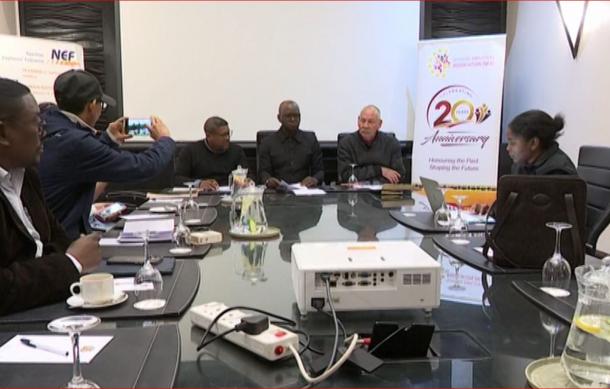
A group of trade unions and employers' representatives have rejected Justice and Labour Relations Minister Wise Immanuel's stance on the composition of the Labour Advisory Council.
They argued that they should be accorded the privilege of nominating representatives to the council themselves.
The National Union of Namibian Workers (NUNW), the Trade Union Congress of Namibia (TUCNA), Namibian Employers' Federation (NEF) and the Namibian Employers Association (NEA) have jointly rejected a directive from Immanuel on how representatives to the Labour Advisory Council are selected.
The organisations, in a joint media statement, said the Minister has no authority over who should represent their relevant bodies on the Labour Advisory Council.
The Labour Advisory Council is established as a statutory forum comprising representatives of government, registered trade unions and registered employers' organisations.
It acts as a conveyor belt that links labour and business with their constituencies on labour matters.
Immanuel had directed that government, trade unions and employers' organisations submit between two and six nominations each for the new council of representatives.
The NEF President Elias Shikongo said tripartism depends upon Government, organized labour and business engaging as distinct, representative and independent partners.
"Since the term of the previous Labour Advisory Council ended in February, the Council has not been reconstituted. The central issue is therefore clear: while the Minister holds the formal authority to appoint members of the Council, Government should not effectively determine who represents workers and employers in a statutory tripartite institution.”
He added that meaningful social dialogue does not diminish Government's authority, but instead strengthens public decision-making by ensuring that laws and policies are informed by the experience of those who will implement them.
Secretary-General of Tucna, Mahongora Kavihuha, stressed that they were basing their argument on the independence of selecting their own representatives and argued that the directive must clarify the legal and policy basis for requiring each constituency to submit six names.
“ILO Convention 87. If you open that document, you will go to Article 3 of that document, which clearly stipulates that there should not be any interference. The trade unions and employer organisations should select the representatives independently from any influence. And that convention is ratified by our parliament.”
Kavihuha added that the Minister was violating that Convention.