


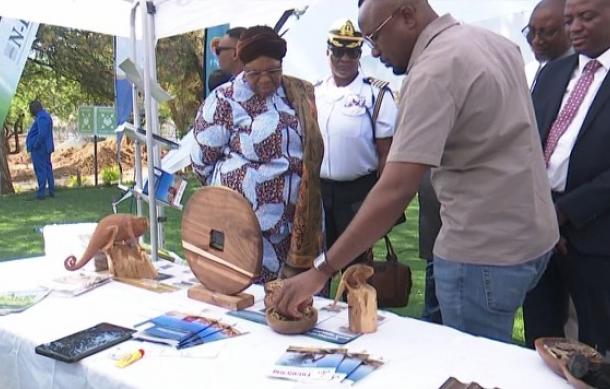
President Netumbo Nandi-Ndaitwah has reiterated the government's commitment to create an enabling environment for agriculture to thrive.
Dr. Netumbo Nandi-Ndaitwah therefore said it is imperative that a conducive environment has to be created for agriculture through connectivity, creativity and access to finance for the sector to serve its purpose.
She made the remarks at the Agri Outlook Conference in Windhoek today.
Dr. Nandi-Ndaitwah noted that the agriculture sector is the cornerstone of the country's socio-economic development, as 70% of Namibians directly derive their livelihood from it through livestock and crop value chains.
She further noted that the sector is also a source of foreign currency through the export of its agricultural products while serving as a catalyst for the manufacturing industry.
Hence, it remains the number one priority in her administration, as the sector has the potential for the setting up of industries through processing plants.
"When discussing with many farmers, particularly in the communal areas, the small-scale farmers, what they are demanding from the government is a market, and we can only have a market that can value the work of our farmers, that can take up all their produce, and that is why the processing plants are very critical. I always say, and I will continue to say, the time has come in Namibia where we must have production centres, and then we make our towns processing centres, while the rural areas and whole farming areas should all be turned into production centres."
She also expressed concerns over the sector's ageing workforce and less interest from the youth in agriculture-related jobs.
"But now the research is there and the facts are there that the future billionaires are those in agriculture. Let us encourage our young people to attract them to agriculture so that, as farmers, you will not be worried about who is going to be in charge of this farm when you are not there."
The government in the Sixth National Development Plan (NDP6) targets to increase the country's value of strategic crop exports from N$1.9 billion to N$2.8 billion by 2030.
"And to this end, as a government, we have the Namibia Agronomic Board, which is actively working with farmers to support your production and to help facilitate access to the market. We also have AMTA, and we know the challenges there. We are going to actively work against those challenges and come up with the solutions that we are all able to do," Agriculture Minister Dr. Inge Zaamwani said.
It further targets to increase the sector's contribution to GDP from 4.6% to 8% and to increase local food production to 80% by 2030 from the current 47%.