


Education has powerful transformative power, but teaching and schooling in rural areas are challenging. However, the dedication and assistance by various stakeholders offer hope for the future.
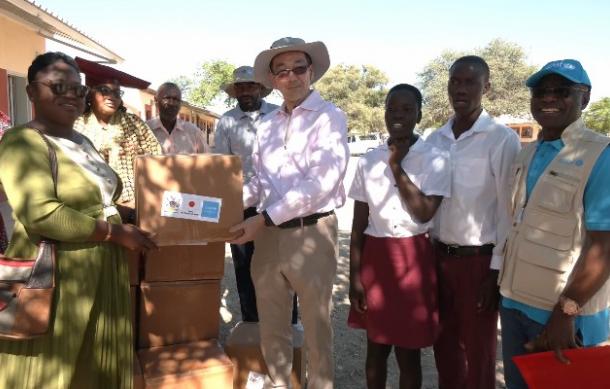
This came to light this week when the Japanese Ambassador and UNICEF representatives visited two schools in the Kunene Region.
The joint field visit's first stop was the Oukongo Combined School, which is about 15 kilometres outside Opuwo. Established in 1995, the school now caters for 388 learners from pre-primary to Grade 9, served by 16 teachers.
A community hostel was also built in 1995, accommodating 60 learners. Four bachelor flats serve as teacher accommodation, while other teachers stay in makeshift corrugated iron structures. There are ten non-functional pit latrines at the school.
Namata Lingeza, Principal of the Oukongo Combined School, explained that "it would really help to have a fully functional hostel; it will help to prevent drop-outs and long-distance walks to and from the school. We lack ablution blocks at school, so we must use nature to relieve ourselves. We would appreciate any help with sanitation."
As part of the visit, Japan's Ambassador to Namibia, Shinichi Asazuma, handed over sanitary dignity kits, consisting of sanitary pads, soap detergents and water-carrying containers.
"I encountered numerous challenges here, particularly the need to construct a hostel and improve sanitation facilities. I sincerely hope that the donation of the sanitation dignity kit will help the learners study better at this school."
Neither the school nor the hostel has running water; the main source of water is from a borehole with one functional tank, and the school shares it with the surrounding community of about eight hundred people.
Sophia Ferdrieck, the regional education director of Kunene, has announced plans to transform the Oukongo Combined School into a secondary school.
"In our region, we have revived the school health integrated plan, trained our stakeholders, and reached out to prevent the risk of HIV infection, which we accomplished in May with support from UNICEF. Additionally, we launched the end of learning poverty initiative, an African agenda introduced for this country in Outjo, and received further support from UNICEF. This is significant for us because it ensures that both girls and boys will be prepared and confident to attend classes and receive an education."
UNICEF Country Representative Sam Ocran lauded the dedication and commitment of the teaching staff in an environment that does not have all the facilities for learning.
"You can see even some of the teachers have made makeshift accommodation; they are staying here to be able to improve learning for the children, and this is really great. I have also seen development ongoing, and this shows commitment from the government because you can see new buildings being constructed that show government commitment to learning in Namibia, and I think, especially in Oukongo, this is very good. I have also seen what partnership and investment can do to improve the learning environment for children because the partnership between UNICEF, Japan, and the government is delivering results."
The UNICEF representative also urged other stakeholders to reach out and assist the school in enhancing learning opportunities for students.