


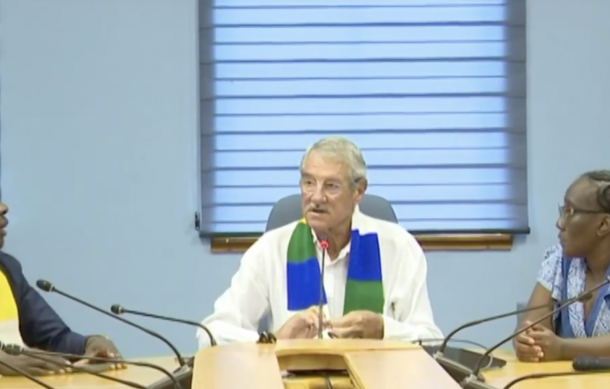
Republican Party, President Henk Mudge has warned against the in-situ leaching uranium mining project, citing health and environmental risks.
Mudge is demanding a moratorium on all exploration and testing activities.
The project is led by Headspring Investments, a subsidiary of Russia's state-owned atomic energy company Rosatom, which targets the Stampriet Artesian Basin (SAB).
The SAB is an underground water source that supports communities, farming, and ecosystems in Namibia, Botswana, and South Africa.
Mudge has questioned the Parliamentary Standing Committee on Natural Resources' decision to allow uranium exploration in the shared Stampriet Artesian Basin.
Mudge says the ISL's chemical injection risks contaminating this aquifer.
He highlighted threats to water quality and health hazards from pollutants seeping into drinking sources, as well as agricultural disruption and irreversible trans-boundary pollution.
"It has already been declared a legal protected water protection area under Namibia's own Water Resource Management Act of 013. And I think this is something that you must take into consideration as we carry on. We have the Water Resource Management Act 2013, that is 13 years ago.
"That law prohibited the pollution of underground water in this area, full stop. It prohibits underground pollution," he pointed out.
Mudge described the aquifer as a non‑renewable resource that took thousands of years to accumulate and cannot be replaced by pipelines or new infrastructure.
"The immediate public release of all water sampling results and the borehole data collected in the Stampriet area and a clear and unambiguous declaration by the Namibian government that the Stampriet Artesian Basin, as a declared water protection area under Namibian law, will not be compromised for any commercial mining activity that poses a risk, however small, to the quality of our water is needed," he said.
Parliamentary Standing Committee on Natural Resources' Chairperson Tobie Aupindi dismissed the criticism as misguided and lacking scientific basis.
Dr Aupindi says the committee does not approve exploration activities but instead plays an oversight role, while key permits are issued by relevant government ministries.
He emphasised that activities currently underway are strictly exploratory, involving scientific studies to determine the extent and viability of uranium deposits.
The committee, he said, has already tabled a report in the National Assembly, which is yet to be debated.
Aupindi maintained the project serves Namibia's long-term strategic interests and could benefit local communities.
He also stressed that uranium's toxic nature makes it critical for decisions to be guided by science, not politics.
"We are talking about a resource, a reserve of a resource in place. And if it's there, and uranium being very toxic in itself, surely you cannot conclusively say that the place is not already contaminated. It is contaminated. That's a fact.
"And now what we need to do is find scientifically safer ways of extracting that for the benefit of Namibians and to treat the water properly so that that water is then made fit for consumption," Aupindi said.