


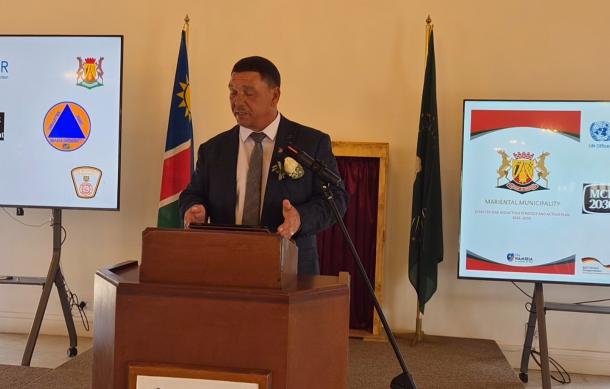
The Mariental Municipality has launched its first Disaster Risk Reduction Strategy and Action Plan for 2026 to 2030, aimed at strengthening resilience against floods, droughts, veld fires and other climate-related hazards. The strategy was officially launched by Prime Minister Elijah Ngurare on Friday.
The strategy positions Mariental among the first municipalities in Namibia to adopt a comprehensive disaster risk reduction framework aligned with the Sendai Framework for Disaster Risk Reduction, the Disaster Risk Management Act and the Making Cities Resilient 2030 initiative.
Prime Minister Ngurare said resilience is about protecting the dignity of every Namibian, regardless of their economic status or where they live.
"Whatever we do, we are perceived to be poor. In that statement, it also means the dignity of every human. Be you rich, be you poor, be you white, be you black, be you economically astute or economically poor. Your humanity, the value of your humanity, is just as equal as any other. Whether you live in the informal settlement or you live in the affluent, the oxygen you breathe and the oxygen they breathe. In a day there are 24 hours. The rich do not have 25. The poor do not have 23. They all have one."
Dr. Ngurare said disaster risk reduction is a shared responsibility that requires cooperation between government, local authorities, development partners, businesses and communities.
"Some are studying in YouTube, some are studying socialism, social idealist, some are studying socialism, some are studying very sophisticated professions. And that is the fruit of independence. In the absence of peace, nothing can be achieved. Imperfect as we are, it is our independence. So therefore, we will achieve this strategy, we will implement this strategy if we bury all else and look at what will be in the national interest."
Hardap Governor Riaan McNab called on the municipality to ensure the strategy translates into action.
"I also encourage the constituency to ensure that the strategy is supported by a well-implemented plan, measurable targets, regular risk assessments, and community participation."
GIZ Namibia Country Director Tobias Gerster congratulated the municipality for becoming one of the first local authorities in the country to adopt a comprehensive disaster risk reduction strategy.
"As development partners, commitment to sustainable urban development, reducing inequalities, and strengthening resilience, the GMC Global strategy is more than a disaster risk management framework. It represents an integrated approach that links climate change, urbanisation, service delivery, governance, and social inclusion."
Gerster reaffirmed GIZ's commitment to supporting Mariental through resilience projects, including improved water access, sanitation infrastructure and regional knowledge-sharing initiatives.
The strategy is expected to guide disaster preparedness and climate resilience efforts in the municipality over the next five years.