


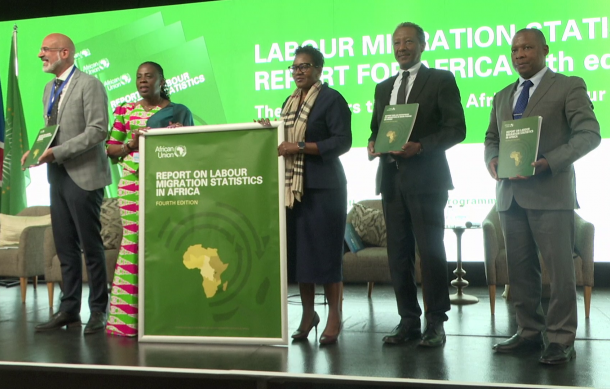
Africa's labour force grew to over 509 million people in 2022, while the number of international migrants on the continent rose to 26 million.
This is according to the Fourth Edition of the Report on Labour Migration Statistics in Africa, launched on Friday during the sixth ordinary session of the specialised technical committee on social development, labour and employment in Windhoek.
Labour migration has become a defining feature of Africa's economic transformation, demographic transition and regional integration agenda.
Africa's population grew from about one billion in 2010 to 1.4 billion in 2022, a 40% increase, with 820 million people of working age.
The labour force expanded by 35.6% from 375.6 million in 2010 to 509.2 million in 2022.
Although the overall labour force participation rate remained stable at 62.1%, gender disparities persist. 71.8% of men participate in the labour force compared with 52.7% of women.
"As I was producing the report, I could see that there is gender disparity issues. Women accounts for around 37% of migration., it calls us as policy makersto ensure that our policies do respond to issues of gender." mentioned Minister of Gender Equality and Child Welfare, Dr Emma Kantema.
The report notes that migrant workers remain concentrated in labour-intensive, largely informal sectors, with services such as trade, transport, accommodation and food accounting for almost 44% cent of migrant employment.
Agriculture and manufacturing absorb relatively small shares at 17% and 5% respectively, while medium-skilled occupations make up around 60% of migrant jobs.
East and West Africa together account for nearly 60% of the continent's labour force, while Northern Africa records the lowest participation rates, reflecting structural and socio-cultural barriers to women's employment.
Yitna Getachew IOM's director for Southern Africa, adds, "The report also reminds us that important data gaps still remain. Many countries continue to face challenges in collecting and analyzing information on migrant workers by occupation and skills, labor migration by sex and age, recruitment practices, labor market outcomes, social protection coverage, and demonstrated labor migration data. Closing these gaps is essential if Africa is to build labor migration systems that are responsive, inclusive, and future-ready."
The report recommends strengthening investment in national and regional statistical systems to ensure the availability of high-quality data that captures differences by gender and age.