


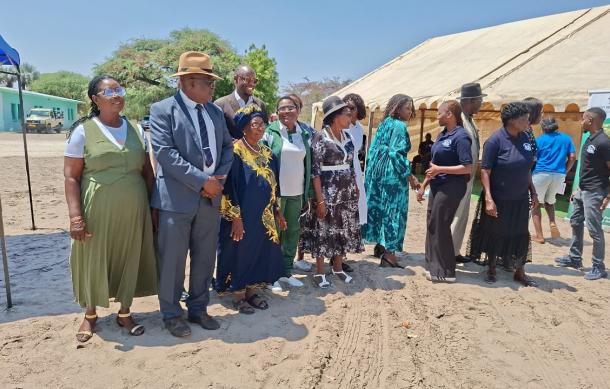
Ponhofi Senior Secondary School in the Ohangwena Region celebrated 50 years of existence on Saturday, reflecting on its rich history, contribution to education, and its role in some of the most significant events in Namibia’s political history.
The school marked the milestone under the theme “Celebrating Five Decades of Excellence, Growth and Impact”, bringing together school management, learners, former learners, community members, government representatives and other stakeholders to celebrate five decades of education and service.
Established in 1976, Ponhofi Senior Secondary School was the first high school in the former Oukwanyama District. The name Ponhofi means “a central place where most people meet”, a description that has remained fitting as the school has grown into an important centre of education and community life.
However, the history of Ponhofi is not only one of education. The school also found itself at the centre of Namibia’s political and social struggles during the 1980s.
Twelve years after its establishment, Ponhofi became the rallying point of the 1988 school boycott against the apartheid South African regime. In the late 1970s, a South African Defence Force (SADF) and police bases were established near the school. The strategy was intended to discourage attacks on the base by the People’s Liberation Army of Namibia (PLAN), the military wing of SWAPO, and to separate SWAPO from the local population.
However, the military presence had serious consequences for the surrounding communities and learners. According to historical accounts narrated at the event, pupils were among those shot, killed and injured by the South African Defence Force.
Despite all these challenges, teaching and learning continued at the school as it grew.
In the post-independence era, the school is faced with learner accommodation challenges, as the hostel cannot accommodate the current learner population. There are more than 1,200 learners from grades 8 to 12. Among those, only 800 are in the hostel. The current hostel was built to accommodate only 480 learners. More than 600 learners are commuters, and this poses a challenge to the learning and teaching environment at the school.
Addressing the gathering, Ohangwena Regional Governor Kadiva Hamutumwa said government alone cannot meet the education demand, but stakeholders can meet the government halfway in their efforts to address education challenges.
Her speech was delivered on her behalf by Joseph Nenghwanya, a member of the Ohangwena Regional Council Management Committee and councillor responsible for Ongenga Constituency.