


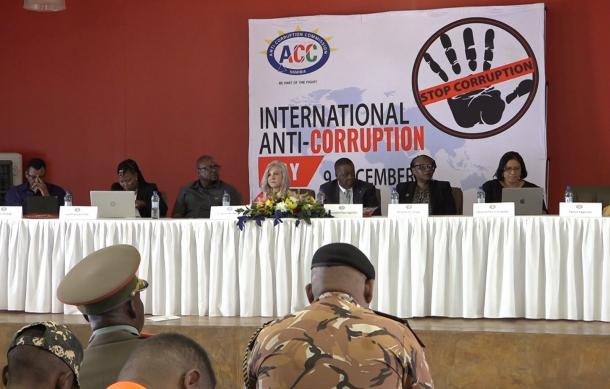
Leaders have described that the observance of International Anti-Corruption Day is a solemn reminder of a shared responsibility borne by governments, institutions, communities and individual citizens to confront corruption wherever it manifests and in whatever form it appears.
Speaking during the International Anti-Corruption Day held at Gobabis, Governor Pijoo Nganate stressed that corruption is often perceived as a problem that exists at high levels of government or within distant institutions. Yet at the grassroots level, he said, corruption is experienced in very real and tenable ways – hence it will require everyone's efforts to cease dishonesty.
"At a grassroots level, identifying corruption begins with awareness. Communities must be informed about their rights, about procedures for accessing service and about the standard expected from the public officials. When people know what is rightfully due to them, exploitation finds fewer rooms to thrive. Transparency empowers citizens to ask questions, to demand explanations and to hold duty bearers accountable."
Deputy Director General of the ACC, Advocate Erna Van der Merwe, pointed out that there is a need for a stronger education and awareness campaign, particularly amongst young people, to enhance the understanding of youth about corruption.
"Our youth are not just the leaders of tomorrow; they are the change makers of today, and by engaging them in crucial conversations about corruption and integrity, in essence, we are indeed sowing the seeds for a prosperous future."
Gantsi Regional Head in the Directorate of Corruption and Economic Crime, Lucy Poonyane Kolo, highlighted that both countries should continue to work together in addressing the issue of corruption, as it has proven to be one of the key factors that affects possible development.
"Botswana and Namibia shared more than just borders; we share history, we share cultural beliefs, societal values and a vision for future integrity. This spirit of unity was formalised in August 2021 when the DCEC and ACC signed a landmark MOU, and this agreement reaffirms our belief that corruption is a cross-border challenge and requires a borderless approach."
Speaking on behalf of the United Nations (UN) Secretary-General was Amanda Semunga of the United Nations Development Programme (UNDP).
"Corruption is a challenge that affects communities everywhere, and its impact is especially visible where resources are limited. When funds meant for rural clinics and families find no medicines, when resources for schools are divided, children may study in overcrowded classrooms without enough books or qualified teachers. When jobs are awarded based on connections rather than merit, or when a young graduate is overlooked for a job not because they lack talent but because opportunities are not distributed fairly, communities lose out on progress."
The commemoration of International Anti-Corruption Day was held under the theme 'Uniting with Youth against Corruption and Shaping Tomorrow's Integrity'.