


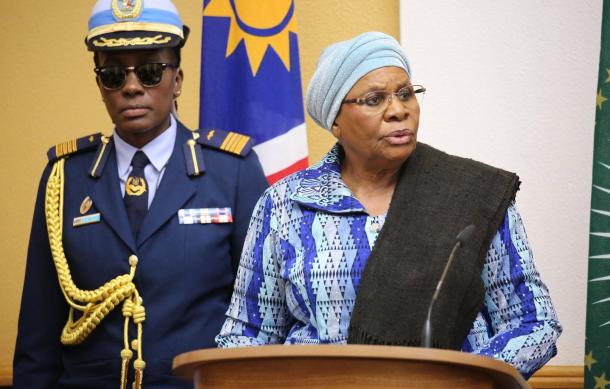
President Netumbo Nandi-Ndaitwah stressed that removing the red line entirely is not straightforward, as it plays a critical role in protecting livestock markets and preventing disease transmission.
She noted that past attempts to enforce physical barriers, such as fencing, have faced challenges, including vandalism by local communities.
She responded to AR leader Professor Job Amupanda, who noted that a former minister of agriculture had indicated that Cabinet had decided to remove the red line, yet the current minister has remained silent on the matter.
He questioned whether the government is moving forward with the removal or maintaining the status quo.
"The former minister of agriculture was here, and he told us that the red line will be removed; the cabinet has decided, and the new minister never said a single word about the red line. So we want to understand what is happening with Your Excellency. Are we coming or are we going on that red line?"
President Nandi-Ndaitwah, however, said the issue must be understood within the context of ongoing animal health challenges, particularly outbreaks of foot-and-mouth disease.
She explained that the government has already reactivated veterinary controls in parts of the south to prevent the spread of the disease.
"Now we have found the market for the animals on the other side of the red line. And what we need is a market. And they are not 100% closed off. Because when you quarantine them, you do this, you do this, and you can still export to them. So that is really what is really happening in this regard. So in a country, you always have to have areas where, when a crisis comes, like what we have now, you have to reactivate them; you have to use them. But in the question of the north, we have to work with the World Animal Health Organization, which has to declare all those areas to enable us really to come to the level where we want."