


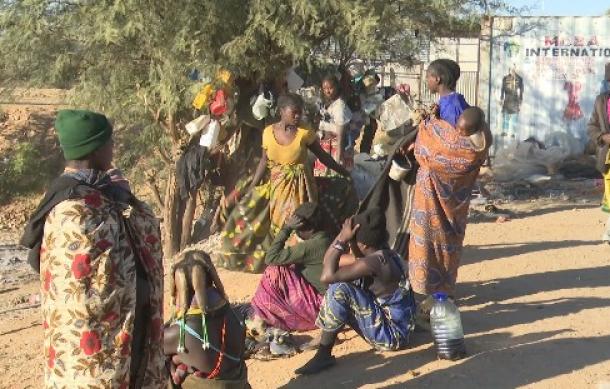
Groups of children, believed to have come from Angola, continue to increase by the day as more children join the ranks.
While the Namibian and Angolan governments have stepped up efforts to have them return home, new groups continue to arrive and have become a familiar sight at traffic intersections across major towns in the country.
The growing number of children on the streets has become a concern for both Angolan and Namibian governments.
Most of these children are believed to come from communities in southern Angola that have endured years of drought, livestock losses and food shortages.
In the city, they spend their days begging from motorists, while their nights are spent sleeping in the open with no shelter to shield them from the cold nights.
Their day begins long before they arrive at the traffic lights.
Opposite the Okuryangava Clinic in Katutura, which has become home to them, the children gather around food stalls, buying breakfast.
The few dollars collected the previous day through begging are spent on vetkoek, often their first meal of the morning.
After eating, they split into groups and head to busy intersections across Windhoek.
There, they weave between vehicles, stretching out their hands in the hope that someone will give them a dollar.
Some are carrying babies on their backs. Others are still of primary school age.
An Angolan man, who requested anonymity, informed our news team that he hails from the same community as many of the children.
He has since obtained Namibian citizenship and has cautioned that sending back the group will be a great injustice.
"These people are akin to the San People, including those from Hakawona. They reside in the mountains and have been raised in that environment. They are unfamiliar with life in the town; they do not know what it entails. There is no schooling, nothing of the sort. They have grown up in the mountains, in the bush, subsisting solely on wild animals, and if there is nothing available, they simply go without. They will endure hunger."
As the sun sets, many will return to this open area.
NBC News observed babies and young children showing flu-like symptoms as temperatures continue to drop during the winter season.
Last year, Namibia and Angola began joint efforts to remove children from the streets.
Children and their caregivers were temporarily accommodated before being repatriated across the border.
The campaign has continued this year.
The Ministry of Home Affairs recently announced that about 700 Angolan street children had been repatriated, with both governments working towards returning more than 1,700 children.
However, despite these efforts, there is a presence of new groups of children in towns such as Windhoek, Swakopmund and Oshakati.