


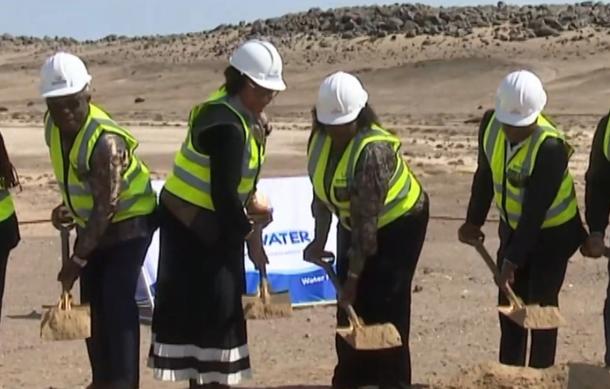
The government is spending nearly N$87 million to replace the ageing Omdel-Wlotzkasbaken pipeline, a critical piece of water infrastructure at the central coast.
The N$86.6 million investment will replace a 10.3-kilometre section of ageing pipeline that has supplied water to the coast for more than four decades.
The government says the project is critical to improving the reliability of water supplies to Swakopmund, Henties Bay, Arandis, and surrounding mining and industrial operations.
"This project, therefore, represents far more than the replacement of the ageing pipeline. It is strengthening the foundation upon which future investments will be made. Employment opportunity and economic prosperity we will build, and it does not do so well, helping to preserve the affordability of our water tariffs since groundwater from the Omdel aquifer remains a more cost-effective source than desalination alone, allowing Namwater to continue offering a sensible blended supply to our people," says MAFWLR Deputy Minister Ruthy Masake.
The existing pipeline, built around 45 years ago, has become one of the most vulnerable sections of the coastal bulk water supply system due to ageing infrastructure and growing demand.
Once completed, the upgraded system will be able to transfer up to 30 million cubic metres of water annually by combining groundwater from the Omdel Aquifer with desalinated water.
NamWater's Chief Executive Officer, Abraham Nehemia, adds, "We understand that the best infrastructure is the one that keeps the communities thinking about other developmental issues and not about the possibility of a dry tap the following day because it works efficiently, safely, and reliably every single day. That is the standard and service level to which Namwater is committed."
The project is jointly funded by the Namibian government and Germany's KfW Development Bank under the Water Sector Support Programme.
Beatrice Lucke is the Country Director for KfW Development Bank.
"The pipelines are buried and stretched quietly across the landscape. And because they are largely unseen, their importance is frequently underestimated. But yet, they are the arteries of a whole water supply system. And their reliability determines whether homes receive their drinking water, hospitals can operate, industries can produce, and towns can continue to grow. So these arteries, they need to be maintained."
Construction is set to begin in early August, with completion targeted for mid-2027.