


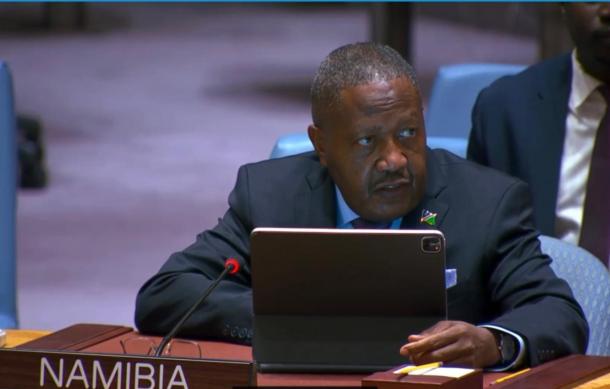
Namibia has called on the United Nations Security Council to move beyond expressions of concern and adopt concrete actions to support the realisation of the Palestinian people’s right to self-determination.
Speaking during the Security Council debate on the situation in the Middle East, including the Palestinian question, Namibia's Permanent Representative to the UN, Ambassador Penda Naanda, underscored that it is vital for the Question of Palestine to remain a priority for the Council and the international community, encompassing all dimensions – political, developmental, economic, and cultural.
Ambassador Naanda said Namibia is deeply concerned by the persisting humanitarian catastrophe in Gaza, where, despite a declared ceasefire, violence and deprivation continue to claim the lives of civilians, overwhelmingly women and children.
He pointed out that the blockade and displacement of thousands of people and restrictions on humanitarian access constitute collective punishment.
Ambassador Naanda said these actions are prohibited under international humanitarian law, emphasising that an effective ceasefire and the urgent reconstruction of Gaza are imperative to support Palestinian economic recovery and institution-building, which are crucial for the aspiration for statehood.
He further expressed deep concern that Israeli actions on the ground demonstrate no intention of halting unlawful practices that undermine peace and stability.
"Such actions not only fuel tensions and restrict Palestinian access to land but also threaten the viability of a contiguous and sovereign Palestinian State and violate international law and UN Resolutions. The Israeli authorities and Defence Forces (IDF) are exploiting the current regional instability to seize additional Palestinian land and enact discriminatory measures, demonstrating a clear disregard for international norms and deepening the realities of occupation and dispossession."
Ambassador Naanda pointed out that the situation on the ground in the Occupied Palestinian Territories continues to deteriorate alarmingly.
He said the New York Declaration on the implementation of the two-state solution and the recent Security Council Resolution on the Comprehensive Plan to end the Gaza Conflict set out a credible framework for peace and recovery.
"Yet, in reality, reconstruction has not begun, and a sustainable ceasefire remains unfulfilled. The absence of tangible implementation of international commitments further exacerbates an already dire situation, as it leads to continued suffering for the affected populations and undermines efforts for lasting peace and stability in the region."