


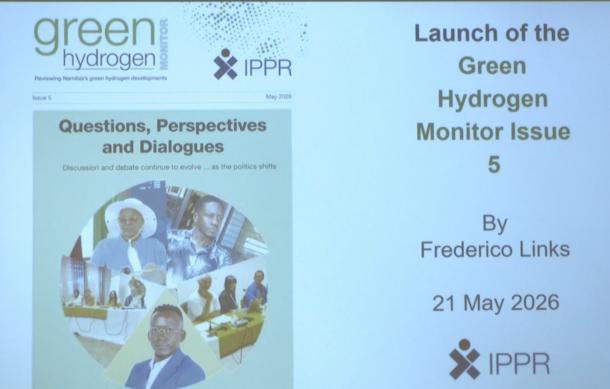
The Institution for Public Policy Research (IPPR) has launched its fifth edition of the Green Hydrogen Monitor, reviewing Namibia's green hydrogen development.
The book features content such as recent signals of movement in the sector, as well as the importance of dialogue with communities in areas with emerging green hydrogen projects before policy implementation.
Project Coordinator for the Green Hydrogen Monitor Projects at IPPR, Frederico Links, pointed out that communities are not opposed to progress; however, the biggest concern is the lack of transparency and awareness regarding how these communities can benefit from these projects and how they will reduce Namibia's carbon footprint, which will have a positive impact on the environment.
"The concerns are focused on how development is implemented and whether it reflects local realities. They are seeking approaches that are inclusive, transparent and respectful of both environmental systems and cultural heritage. And that's really what it comes down to. Inclusivity, transparency and respect for people's environments."
According to a skills report from the Namibia Investment Promotion and Development Board (NIPDB), also featured in the book, Namibia's tertiary education system does not align with economic and emerging sectors, requiring specialisation and certification in almost all occupational fields in the sector.
"Some drastic proposals are made, and these have been reported, for instance, that expat skills actually be imported because Namibia is not in a position and won't be in a position anytime soon to be able to deliver the quality and quantity of skills needed for these high-tech sectors, such as the green energy sector that we are talking about when we're talking about the green hydrogen sector."
The Green Hydrogen Monitor Issue 5, as well as previous editions, can be accessed and downloaded via the IPPR website.