


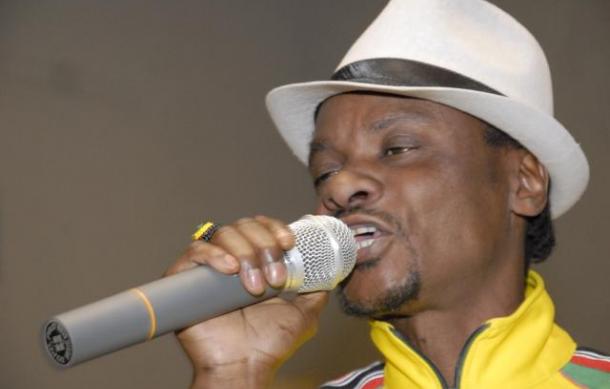
Late music star and Namibian reggae icon, Ras Sheehama, always used his music to convey messages of love and to protest social conditions, leaving consumers of his music with food for thought.
Three years ago, the NBC sat down with Ras to talk about the person, the journey of his music and the influence music had on him and his life.
"I was born Omeho Yashitala Sheehama, the two eyes that observe… I was born Omeho, now known as Ras Sheehama, now known as Ras Sheehama, the musician; otherwise, I am a very simple person. I was not born in town; I was born in a small village, a peaceful village," he told us at the time.
While attending primary school in 1979, the young Omeho, aged about 12, crossed into Angola with a group of his schoolmates to join the fight for the freedom and independence of Namibia. At that time, his father, David Sheehama, had taken a strong stance in support of SWAPO.
"So we had to cross the borders either into Zambia or Angola to fortify the revolution," said Ras.
His journey into Angola is a story on its own, but in his words, while in Angola, music started calling stronger.
"We got into Angola, and we met with Jackson Kaujeua, who had a guitar in the camps, entertaining people, and he was a teacher at that time. We got inspired; we followed him from the classroom sometimes to his tent, and sometimes he needed his privacy, and he would tell us, 'You guys have to go now and come back tomorrow'."
Eventually, Omeho left for Zambia, and while in a refugee camp there, he bought a self-made guitar from a friend for ten Zambian kwacha.
"It was not his; he found it in the trench because the Nyango refugee camp used to be a Zambian military camp, so they left that scrap there, and then we put strings on the thing, and we tuned it; the tune we called 'African tune' with three strings, that's what we were strumming on. So later things started progressing; we got donations of guitars from peace-loving countries all over the world, so we started a band called Nyango School Band."
In 1985, he left for Nigeria to attend secondary school at a public school in the then capital, Lagos, which the young Omeho experienced as a melting pot of music.
"And then my composition started kicking in now, so for my song Cassinga, which I composed in a class in Nigeria, the boys were just going like, 'What are you singing about?' because I was singing in my language, but when I sang, 'My momma, my brother died,' you understand, so they realised it is a revolutionary song this guy is singing."
Speaking of the events of the bush war, and looking back, Ras said it toughened him up, heightening his senses, thinking of the many with whom he shared a bed, a tent and a meal.
"It is an experience, both good and bad, for life to make you stronger in life. It is very good, but sometimes you can be traumatised because we left home when we were very young. Twelve and a half years old, you are still a child, my friend. At that time, Angola was the most militarily active country; nearly every hour, there was a battle in Angola, nearly every second someone was shot, and nearly every second someone was burnt. This illustrates how dire the situation was during that period."
On 14 March 1980, a year after he left Namibia, Ras' father was assassinated by gunmen at his house.
Music, according to Ras, was an important vehicle to work through such experiences.
"Music is a therapy, especially to us. Even now, I use music as my therapy. I don't go to people to be helped; I take a guitar and play a song like Inotilla, and you say in your brain, 'Ras, it is what it is; don't fight it if you are not stronger than it; prevent it from harming you."
In the words of his long-time friend, Jackson Wahengo, in a post on X, Ras poured all the pain and misery into music, the only weapon he knew.